
Sunday, April 11, 2010

The Mighty Mite


Got allergies and just think that it's the pollen in the air? Maybe your home is being over run by mites.That's dust mites of course! 

Just imagining these dust mites living in your pillow by the millions, eating your dead skin and hair, is enough to make anyone think twice about these pests. Dust mites are microscopic (smaller than 1/70th of an inch) and thrive on sloughed-off human and animal skin. 70% of dust is human skin and the remaining 30% consists of pet dander, dirt, fibers, mold, bacteria and insects. 

High concentrations of dust mite allergen are a significant risk factor for the development of allergic diseases such as asthma and hay fever. Studies at the National Institute of Environmental Health Sciences (NIEHS) suggest that more than 45% of U.S. homes have bedding with dust mite concentrations that exceed a level equated with allergic sensitization.
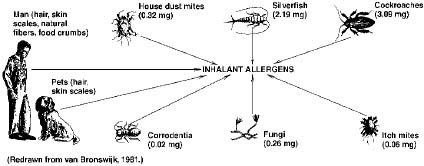
Dust mites thrive in warm, dark, moist places. They thrive in bedding because that is where they find their biggest meals. Humans shed about 1/5 ounce of dander (dead skin) each week. A typical used mattress may have anywhere from 100,000 to 10 million mites inside. It's the feces and body parts from the dust mite that are the allergens, so simply killing the mites won't remove the allergen. 

How to Minimize and Remove Mite Populations:


  • Direct sunlight kills dust mites, so hang bedding in the sun whenever possible.
  • Dust mites die when the humidity drops below 40%. A dehumidifier would help if you live in a humid climate.
  • Wash bed linens once a week in hot water. Water temps need to be above 130 degrees F or higher to kill mites.
  • Steam-cleaning carpets.
  • Vapor steam-cleaning. 
  • The natural lanolin in wool repels dust mites. Yet another reason to buy wool bedding.
  • Eliminate wall-to-wall carpeting. Carpeting accumulates pounds of dust mites, dirt, pesticides and other toxins brought in on shoes, feet and pet's paws over the years. 
  • Freezing stuffed animal toys (in a tightly closed plastic bag) in the freezer for 24hrs will kill but not remove the dust mite residue.
  • Clean weekly.  
Scheduling a regular cleaning routine will help you accomplish the tasks needed to keep dust mites at bay. Find one small area that you can clean everyday. Spending just 10-15 minutes a day on a task can make the cleaning project as a whole not seem so daunting. Pretty soon your cleaning routine will become habit and you can breathe deeply in your home with confidence.

Source Material: Home Enlightenment by Annie Bond

Sunday, March 28, 2010

Children's Pajamas - A Flaming Issue


So the big question here is, do your concerns about fire safety outweigh the use of chemicals and their effect on the environment and your child?

Children's sleepwear has been the center of controversy since the 1970's when the now titled group Consumer Products Safety Commission (CPSC) specified that sleeping garments must self extinguish when exposed to an open flame for 3 seconds. The garment must also pass the test after 50 wash cycles!

It's hard to say it better than this article on the flame-resistant baby pajamas controversy.

Polyester and cotton and the most common materials used to make children's pajamas. Most synthetic fiber sleepwear has a flame retardant inserted into the fabric fiber, including most polyester fabrics, as opposed to the fabric being “chemically treated” with a flame retardant.  If they are treated with flame retardants, they must be labeled as such. Depending on the company, chemicals used on pajama fabrics could include chlorinated and brominated flame retardants, inorganic flame retardants such as antimony oxides, and phosphate-based compounds. Like I've mentioned before polybrominated diphenyl ethers (PBDEs) accumulate in the environment and our bodies and have been linked to compromising the function of our nervous, reproductive and endocrine systems. North Americans have the highest body burden of PBDEs in the world.

The CPSC recommends that children's pajamas be either flame resistant or snug-fitting. Snug-fitting sleepwear does not have to be treated with flame-resistant chemicals. The idea is that snug-fitting pajamas have less air spaces and therefore less oxygen that can accelerate flames. Pure wool sleepwear would also be exempt from mandated treatment.

I think it is crucial to ask not only what is important for your child but what will best benefit our home, planet Earth. By purchasing organic or natural fiber clothing you are supporting companies that are investing in the healthy future of this planet and all its inhabitants.

Additional Pages of Interest:
Guide To Less Toxic Products
5 Minutes For Going Green


Friday, February 12, 2010

Your Child's Mattress Stinks


How many well meaning parents do you know that upon learning of their expectant child have prepared the best nursery possible? New paint, new carpet, new furniture, new clothes, etc... Has the parent-to-be made their own paint, purchased low-VOC (volatile organic compounds) paint, installed natural fiber carpet with natural latex or jute backing, made or purchased furniture without pressed wood, made or purchased natural fiber clothing? If not, then they have unsuspectingly created a ultra-toxic environment for the newest addition to their family.

Children are especially sensitive to chemical exposures. Evidence is emerging that because of a child's dynamic growth and development, they have an increased risk to certain diseases in part from exposures to environmental chemicals during childhood.


The Crib Mattress
Crib-size mattresses are usually waterproof which means that the covering is made out of some kind of plastic (oil). Typically, plastic coverings are made of polyvinyl chloride (PVC) covered with cotton or polyester layers, which as you probably guessed emit toxic fumes that are suspected carcinogens and can cause acute toxicity to the respiratory tract.

A popular material used to fill mattresses is polyurethane which of course is made from petroleum and highly flammable. Additionally, polyurethane is found to not break down in landfills therefore contributing to long term waste problems. Polyurethane poses a high fire hazard, thus enters the use fire retardants.

According to this blog, in 1972, California passed legislation requiring flammability standards for upholstered furniture and baby products like high chairs, strollers and nursing pillows. Manufacturers met these new standards by using inexpensive, toxic and untested flame retardant chemicals. In each animal species studied, these brominated and chlorinated flame retardants were shown to cause cancer, birth defects and neurological, reproductive and endocrine disruption. As mentioned in my pillow blog, the most pervasive fire retardant contaminant is polybrominate dipheylethers (PBDEs) which can increasingly be detected in mother's breast milk. Californians, in fact, have earned the dubious honor of having the highest amount of toxic flame retardant chemicals in their bodies of any people on the planet.

USA Today: Fire Retardant found in toddlers' blood


Solutions 
Choices are limited when it comes to finding a mattress that has not been treated with fire retardants. Because wool naturally absorbs and releases water and is resistant to fire, dust mites and mold, it is an excellent choice for a mattress. Make sure you get organic or 'PureGrow' wool. Another option is organic pure latex (rubber). Be sure the latex is not a blend and has not been treated with drying chemicals. Like wool, natural latex is antimicrobial, resistant to dust mites, mildew and fire and breathes which wicks moisture away from the body. Organic cotton mattresses are also an improvement but due to federal regulations they are treated with a fire retardant.

If purchasing a new mattress is not in the budget you can seal in some of the synthetic fumes from mattresses and pillows by using a barrier cloth encasement. Barrier cloth is made of cotton that is so tightly woven (often 300 threads per inch) that it blocks fumes from passing through its weave. Make sure it's organic and not made of plastic which will outgas chemicals, totally defeating the purpose!

Helpful Resources

 I do not have children and a wool mattress is an expensive endeavor so, unfortunately, it still sits on my wish list. My newest mission is to search out an organic barrier cloth. We have a mattress pad now but I'm sure if I looked I would see that at least part of it, if not all, is made out of polyester. More toxic outgassing in addition to Eric's farting. Ha! I can't wait to get an organic wool mattress for healing, rejuvenating sleep!


Next Time: Children's Sleepwear and Fire Retardants.


Sunday, February 7, 2010

Pillow Talk


I suspect that there is a great misconception that the products we can purchase from a business must be safe for our use. How else could they be available to us? Somebody has done the testing to ensure a products safety right? Well, this isn't always the case, which puts the responsibility on the consumer to do their own research.

You think, hey I need a new pillow so I'll run out and get the cheapest one I can find. But have you asked yourself, what is that pillow made of and what possible chemical treatments have been applied to this pillow? We spend approximately 1/3 of our life in bed. So why not make it as safe and healthy as you can? This blog is the first in a series that will peel back the covers of your bed.

We spend our nights tucked into our beds with our noses buried in or next to our pillows. Because of this, your pillow is the most important part of having a healthy bed. Unless you have a pillow made of natural fibers, you are unsuspectingly breathing in fumes that the pillow is outgassing.

Consider a polyester fill/cotton shell pillow. Polyester is a synthetic material (plastic) that is made from polyethylene terephalate (PET), a derivative of petrochemicals (oil). It can give off fumes of plastic, like when you smell a new ziploc bag. The weave of a pillow case is too loose to block these plastic fumes. Also, Polyester/cotton-blend bedding is heavily treated with a formaldehyde-based resin which also outgasses. Low levels of exposure to formaldehyde can irritate the eyes, nose and throat, cause skin problems, serious breathing problems and can increase your risk of certain kinds of cancer. OSHA regulates formaldehyde as a cancer-causing substance.

It's very likely that your pillow has also been treated with a fire retardant. A significant source of human exposure to one type of flame retardant chemical comes from polybrominated dipheylethers (PBDEs). These chemicals are long-lasting in the environment, our bodies and are being linked to irreparable developmental and reproductive disorders.

Does any of this sound like something you want to be breathing at least 1/3 of your life while trying to enjoy restful and peaceful sleep?

Some Natural Fiber Alternatives:
Organic Cotton
Organic or "PureGrow" Wool
Buckwheat
Kapok
Down
Syriaca Down

I purchased my "PureGrow" Wool pillow several years ago at a local eco-friendly store. Wool is naturally flame resistant, inhospitable to dust mites and resistant to mold and mildew but does tend to lose some of its loft. To freshen my pillow, I simply hang it out on the clothes line in the sun. It has been a wonderful and welcome addition to my healthy sleep habits. More than likely, you will not find these natural fiber alternatives at a Walmart or Target and will have to seek out either a local eco-friendly store or online resources which there are now many. Please always make an attempt to find a store close to home.


Next time.........A look at fire retardants and the chemical applications used on children bedding products.

Tuesday, January 26, 2010

Dusting Off The Research


I know nothing has happened on here for many, many months, nearly a year! But I'm getting back in the routine and will change that. I am resuming my research so that I may bring you useful information about toxins in our environment.

Much has happened since my last blog. My partner, Eric, and I hiked the Pacific Crest Trail. It's a national scenic trail that winds through California, Oregon and Washington. It covers 2,650 hiking miles from the Mexican border to the Canadian border. It's hard to summarize the experience. It was hard and yet incredibly fun too. All the blisters, hot days, and tumbles were well worth all the amazing friends we made on the trail. While out there I wasn't sure that I wanted to do more long distance hiking. But soon after leaving the trail, returning to the hiking community was all Eric and I could think about. If you want to read more about our adventure you can visit our PCT trail journal.

We've had a slow transition trying to acclimate back to life with beds, tv, jobs, stuff and moving cars. Last April, we moved our belongings from Arcata, Ca to Ukiah, Ca, where we now live. Ukiah is where I grew up......sort of. My 'home' is about a 30 minute drive outside of town up a rough and bumpy dirt road on Smart's Mountain. But Ukiah is my hometown and we are now living in the house where my grandparents used to live. There is much cleaning and sorting to do in the house and the yard needs an overhaul. I feel that this home provides us a place to transition into the next phase of our life. The sustainable phase! I hope that in not too many years, we will be able to live up on the mountain, build our own natural home and grow a bountiful garden!

Aside my toxin research is my newest obsession, bicycle advocacy. Ukiah certainly is no Arcata when it comes to biking. I can go a whole day here and not see anyone else on a bike. Sad! Ukiah is not that big of a town and people could very easily bike to their destinations. Rather than let this totally bum me out, I'm seeing it as an opportunity to influence change. I've slowly found others that want to make Ukiah a safer community in which to ride bikes. Thus starts the quest to create a bicycling advocacy group.

So, stay tuned for some more toxic updates!

Monday, April 6, 2009

Wishes

I wish I'd had more time to post here before Eric and I left for our PCT adventure. The posts do take time and lots of research. It's not easy to find all the gory details about the carcinogens we come into contact with everyday.

So, please stay tuned because I will continue it after Eric and I complete the PCT sometime in October.

Thursday, February 5, 2009

Skin, Your Largest Organ

When you go to the store and purchase shampoo, lotion, soap, fragrance, makeup, or sunscreen, do you consider whether or not that product is safe to put on your body? Do you assume that because it is there for sale, it must be safe for use?

Your Skin
Your skin is your largest organ. It acts as a waterproof, insulating shield, guarding the body against extremes of temperature, damaging sunlight, and harmful chemicals. Your skin also functions as a medium through which toxins are removed from your body. Despite the amazing features of your skin, ingredients from skincare products are absorbed in minutes through your skin and into your bloodstream. Many of the ingredients in skincare products are already known, or currently being found, to cause cancer. Why are these dangerous personal care products allowed to remain on the market? Because the FDA, which is responsible for regulating these products, spends almost no time, money or effort actually investigating the safety of such products. Instead, the FDA spends the vast majority of its time approving new prescription drugs.

Partial list of known harmful chemicals:

  • Aluminum
  • Artificial fragrances
  • Benzophenones (dixoybenzone, oxybenzone)
  • Cinnamates (cinoxate, ethylhexyl p-methoxycinnamate, octocrylene, octyl methoxycinnamate - OMC)
  • Dibutyl phthalate
  • Diethanolamine (DEA)
  • Digalloyl trioleate
  • Ethylhexyl p-Methoxycinnamate
  • Formaldehyde-releasing preservatives such as DMDM hydantoin quaternium-15, and diazonlidnyl urea
  • Isopropyl Palmitate
  • Lanolin and Acetylated Lanolin
  • Menthyl anthranilate
  • Methylisothiazoline (MIT)
  • Mineral oil
  • Nitrites (caution: their presence does not have to be disclosed)
  • Octocrylene
  • Oxybenzone, benzophenone, benzophenone-3
  • PABA and PABA esters (ethyl dihydroxy propyl PAB, glyceryl PABA, p-aminobenzoic acid, padimate-O or octyl dimethyl PABA)
  • Padimate-O (Octyl dimethyl paba
  • Para-aminobenzoic acid, PABA
  • Parabens - (butyl-, ethyl-, methyl- and propyl-parabens)
  • Petrolatum
  • Phenol
  • Phthalates
  • Propylene Glycol
  • Polyethylene Glycol (PEG's with any number)
  • Salicylates (ethylhexyl-, homosalate and octyl-salicylate)
  • Sodium Lauryl and Sodium Laureth Sulfates
  • Talc
  • Triethanolamine (TEA)
  • Urea, Imidazolidinyl, Diazolidinyl Urea and/or DMDM Hydantoin
  • Urocanic acid

List from http://www.best-mens-skin-care.com/ingredients.html


Pick One Product
It can be daunting to try to weed out products that are unsafe for your use. My challenge to you is to investigate one product that you currently use. Go to Skin Deep: Cosmetic Safety Reviews and check that one product and its ingredients. If it receives a low hazard rating, continue to use it. If you don't like what you see, use the above list to help you pick out a new product. Do your skin one big favor this week!


Products I use:

Aubrey Organics shampoo/conditioner

Avalon Organics hand/body lotion

Laef's natural and organic deodorant

Deep Steep organic hand soap

CitraSolve dish soap/multi-purpose cleaner

Seventh Generation laundry soap

Ecover stain remover

Badger sunscreen/chapstick